
What is included?
-
Transport in an executive bus, with air conditioning, toilet, and minibar for over 30 passengers. Below 30 passengers, transport may be done in a minibus and below 13 in a van (subject to acceptance by families and location)
Snack on board on the way
Water available during the trip on the bus
Development of activities according to the itinerary
Team of Ivian monitors uniformed and equipped with radios
01 Rescuer
02 Accompanying teachers from the school by bus
01 Licensed Tour Guide from the Ministry of Tourism accompanying the group throughout the trip - Mandatory by Law
Accompaniment of Rescuer and owl monitor
Tickets and bookings
Accommodation at Eco Resort Itamambuca
Meals mentioned in the itinerary
Raincoat for students (if necessary)
Travel Insurance
WhatsApp group with the guardians before and during the entire trip for sending information and MANY PHOTOS AND VIDEOS
What is not included?
- Expenses at technical stops at gas stations
- Expenses for "souvenirs" purchases
Gallery
Introduction
The northern coast of São Paulo forms a rich environment for the development of environmental studies. Even though it is located in one of the most populated areas of Brazil, it has one of the most preserved regions of Atlantic Forest and marine ecosystems, along with an important history in the formation of the State from the sugarcane cycle to the beginning of the coffee cycle.
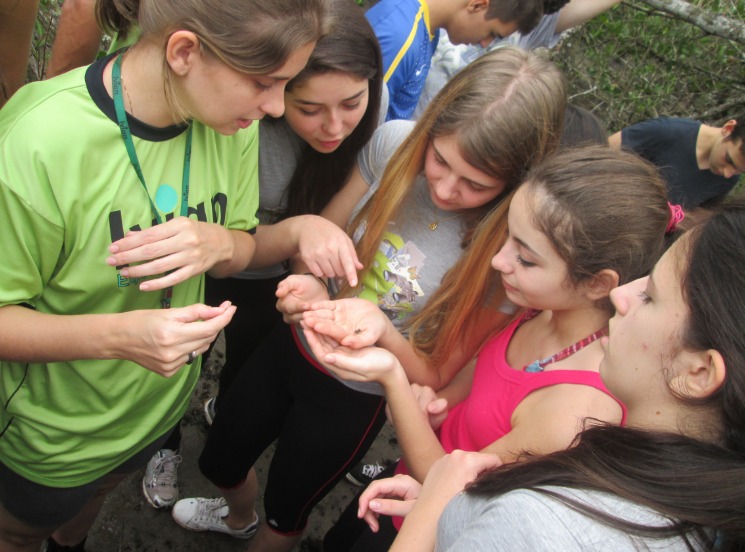
Methodology - Through a methodology in environmental studies, all our activities are integrative, where the student becomes the main creator of knowledge and not just a receiver, using all senses: sight, touch, smell, taste, and hearing, taking the liberty to expand this framework to a “new sense,” that of integration with the environment, perceiving themselves as part of the environment to be studied.
General Objectives - To engage the student with the coastal environment, often already known, but altering the way of understanding and visualization, perceiving the integration of geographical, physical, and biological aspects with the historical formation of the country and the current importance regarding the climate dynamics of different regions, involving the economic relationship of the use of marine organisms and tourism exploitation.
Specific objectives:
• To perceive differences between metropolises, inland cities, and coastal cities, mainly understanding the differences in housing, work, clothing, among others.
• To understand the importance of the Brazilian coast in the historical formation of Brazil, great navigations, maritime exits from major economic cycles, gold, sugarcane, and coffee.
• To understand the dynamic process of beach formation, to verify the relationship between sea waves and sand grain size, and how weathering factors observe the tide cycle as a participating event in formation, relating living beings as part of the process.
• To observe the rocky shore ecosystem, understanding its ecological interactions and its importance for the marine ecosystem as a whole, perceiving zones of distribution of fauna and flora influenced by the variation of the water column in the tide cycle.
• To perceive the importance of astronomy knowledge in navigation, and of new scientific knowledge as determining factors in marine cycles, the gravity of the moon and sun in tide variations, as an example.
• To verify the importance of ocean currents in the distribution of heat on the planet, the sea as a creator of air mass and its importance in the water cycle on the planet.
• To analyze the differences of the marine ecosystem from other ecosystems, to observe the different types of living beings and understand the evolutionary adaptations in the beings that live in this environment.
• To know the distribution of organisms by types of locomotion and distribution by light intensity.
• To analyze how the marine ecosystem is important for the economy, verifying the economic relationship with its fauna and flora, fish stocks, marine farming, and algae farms.
• To visualize physical aspects of vessels, hydrodynamics, means of energy, sail or motor, to understand what is buoyancy, gravity, and other physical concepts used in boats.
• To know the insular ecosystem, verifying the way of the appearance of non-aquatic life in distant places, isolated developments.
• To understand the relationship of Anchieta Island with the history of political prisons.
• To observe the Atlantic Forest ecosystem, knowing its main characteristics.
• To understand the relationship of the mangrove ecosystem with the marine environment, to know the plant adaptations for survival in this peculiar environment, its function as a nursery and recycling of nutrients for planktonic life.
• To identify the living beings studied in their biological classification, understanding the characteristics that distinguish them.